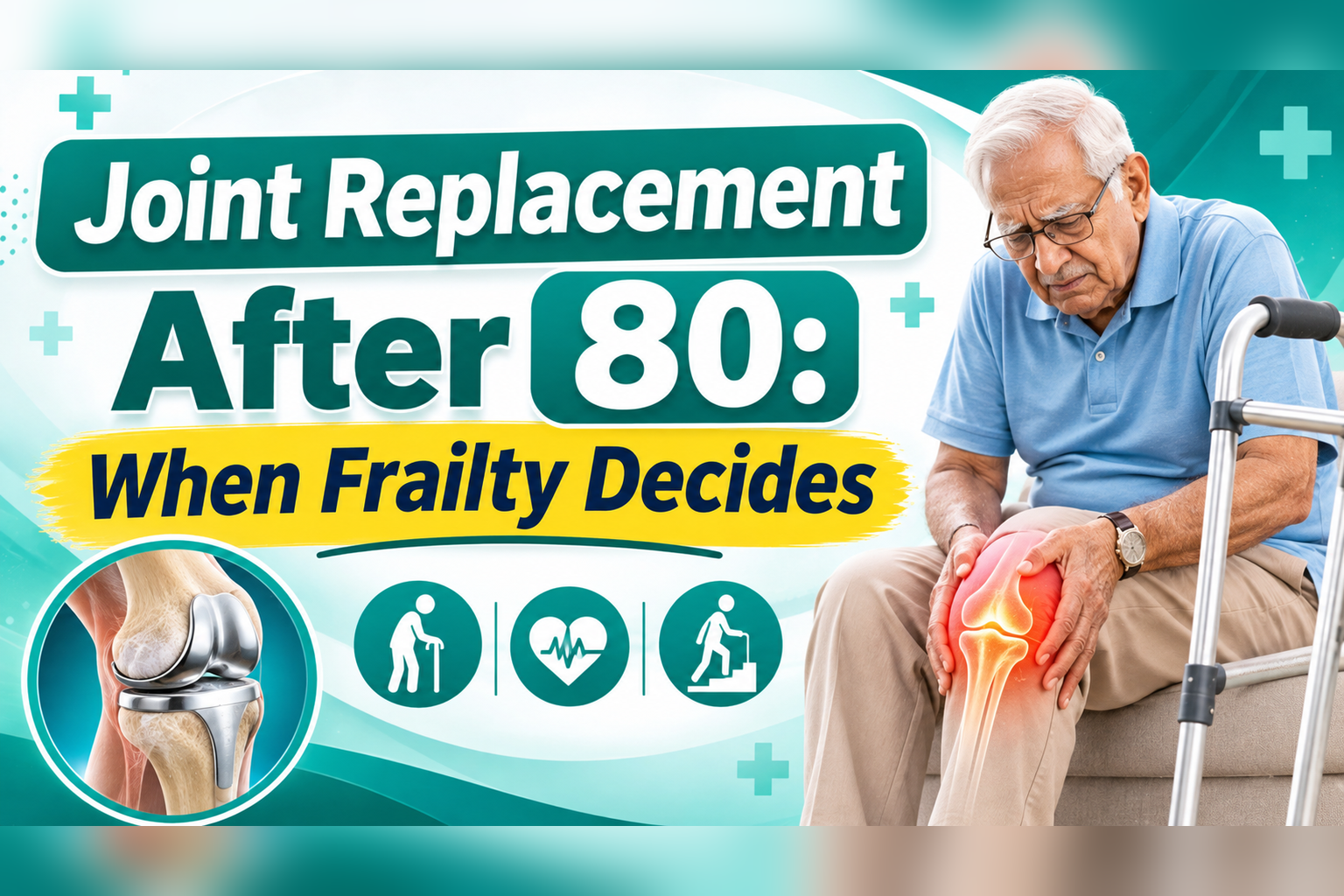
Joint Replacement After 80: When Frailty, Not Age, Decides the Answer
Chronological age is a poor guide to surgical risk in later life. For patients in their eighties, the more reliable question is how much physiological reserve remains, and that is precisely what frailty assessment is designed to measure.
Key Points
- In a US national database of 12,026 patients older than 80 undergoing knee replacement, 3.5% had a major complication within 30 days and 0.3% died.9
- Frailty separates higher-risk from lower-risk patients. Across 460,594 hip and knee arthroplasty patients, frailty was associated with a pooled mortality risk ratio of 2.46.6
- In the Longitudinal Ageing Study in India (wave 1), 29.2% of older adults were frail and 58.8% pre-frail.2
- Between one-third and one-half of people awaiting hip or knee replacement are frail or pre-frail.19
- Frailty can be assessed in an outpatient visit, and parts of it may be improved before surgery, though evidence for the benefit of preparation is still maturing.17,18
Consider a typical scenario. An 82-year-old retired schoolteacher in Gurugram has not climbed the stairs to her own bedroom for two years. Her X-rays show advanced osteoarthritis of the right knee. Her son, who lives abroad, has read that surgery beyond eighty is dangerous. Her family physician says the opposite. Both are partly right, and neither is answering the question that matters.
That question is not whether she is eighty-two. It is how much reserve she has: the strength of her muscles, her walking speed, her nutritional state, the condition of her heart, lungs and kidneys, her cognition, and the support waiting for her at home. Geriatric medicine has a name for the sum of these, frailty, and a growing body of orthopaedic research shows that it predicts outcomes after joint replacement far better than the number on a birth certificate.
This article extends our earlier discussion of knee replacement after 70 into the next decade of life, where frailty becomes the dominant variable. It sets out what the published evidence shows, what the Indian data suggest, which risks rise with age, and how patients and families can judge whether surgery is the right decision. Dr. Logani and the team at the Joint Replacement Centre see this question daily. For the bone-health dimension, see our companion article on vitamin D, osteoporosis and joint health.
1. Why a Number Misleads
Octogenarians share a decade of birth but not a biology. Two patients of eighty-two may differ as much in physiological reserve as a fit sixty-year-old and a bedbound seventy-year-old. Surgical outcome data bear this out.
In a Hong Kong series of fast-track knee replacement in patients over 80, octogenarian status did not itself predict complications. What did predict them was a Charlson Comorbidity Index above 5, a history of major stroke, and a history of peptic ulcer disease.11 In other words, the burden of disease mattered; the age did not.
The largest single description of outcomes comes from the American College of Surgeons NSQIP database, which captured 12,026 patients older than 80 who underwent elective total knee replacement between 2008 and 2014.9 The 30-day results are summarised below.
| 30-day outcome | Patients | Share of cohort |
|---|---|---|
| Major complication (for example deep infection, pulmonary embolism, myocardial infarction) | 422 | 3.5% |
| Minor complication (including bleeding requiring transfusion) | 2,316 | 19.3% |
| Bleeding occurrence requiring transfusion | 2,074 | 17.2% |
| Unplanned readmission | 566 | 4.7% |
| Death within 30 days | 38 | 0.3% |
Source: Yohe et al., Geriatric Orthopaedic Surgery & Rehabilitation, 2018.9 Bleeding requiring transfusion accounted for the large majority of the minor complications recorded.
The same study identified who fared worse. Patients classified as ASA grade 3 or higher had markedly greater odds of death (odds ratio 6.1), and those partially or wholly dependent for activities of daily living had greater odds still (odds ratio 8.9) and a threefold higher likelihood of unplanned readmission.9 Dependence in daily activities is, in effect, a clinical marker of frailty.
Reading these figures with care. The patients in these studies were selected: each was judged fit enough for elective surgery by a surgical team. The numbers describe the outcome of careful selection, not the risk for every person aged eighty or more.
2. What Frailty Is and How It Is Measured
Frailty is a clinical syndrome of diminished physiological reserve. A frail person can appear stable at rest yet decompensate disproportionately when exposed to a stressor such as an infection, a fall or an operation. It is distinct from disability and from the mere presence of several diseases, although the three frequently overlap.
Three instruments dominate the literature. The Fried phenotype scores five physical criteria: unintentional weight loss, self-reported exhaustion, weak grip, slow walking speed and low physical activity. Three or more makes a person frail; one or two, pre-frail.3 The Clinical Frailty Scale is a nine-point clinical judgement, from very fit to terminally ill, that can be completed in minutes at the bedside, with a score of 5 or above indicating frailty.4 The modified frailty index (mFI-5) is a five-item score built from comorbidity and functional status, and was the most frequently used index in a 2025 systematic review of orthopaedic frailty tools.5
| Instrument | What it assesses | Interpretation |
|---|---|---|
| Fried frailty phenotype (2001) | Weight loss, exhaustion, grip strength, gait speed, physical activity | 3 or more criteria: frail. 1 or 2: pre-frail. |
| Clinical Frailty Scale (2005) | Clinician-rated fitness, function, comorbidity and cognition on a 9-point scale | Score of 5 or above: frail. |
| Modified frailty index, mFI-5 | Five comorbidity and functional-status items, scored 0 to 5 | Higher scores indicate greater frailty and risk. |
A caution is warranted. There is no single agreed definition. A systematic review of 82 orthopaedic studies identified 24 different frailty instruments,21 and a review restricted to hip and knee arthroplasty found 13 instruments applied across 32 distinct outcomes.22 The direction of the finding is consistent, but the measurement is not, which is why a thoughtful clinical assessment is more valuable than any single score.
Frailty in India is common and unevenly distributed
Indian data come mainly from the Longitudinal Ageing Study in India (LASI), a nationally representative survey. In its first wave, 29.2% of participants were classified as frail and 58.8% as pre-frail. Frailty was more prevalent among women (37.3%), among those with no formal education (37%) and in rural residents (31%).2 For comparison, global estimates place frailty at roughly 10% of older adults.1
The demographic trajectory makes this a growing concern. The population aged 60 and above in India is projected to rise from 104 million (8.6% of the population) in 2011 to 319 million (19.1%) by 2050.1 Orthopaedic surgeons in India will therefore meet frail and pre-frail patients routinely, and structured frailty screening before elective joint surgery is a practical necessity, not an academic refinement.
3. What the Evidence Shows for Patients Over 80
Studies comparing octogenarians with younger patients after knee replacement point in a broadly reassuring direction, with some important qualifications.
| Study | Design | Principal findings |
|---|---|---|
| Yohe et al., 20189 | 12,026 patients over 80, US national database, total knee replacement | Major complications 3.5%; 30-day mortality 0.3%; readmission 4.7%. |
| Seo et al., 201510 | 141 octogenarians compared with a younger group, 1-year follow-up | Knee Society knee score rose from 63.6 to 83.2. Systemic complications 3.4% vs 1.2% and surgical complications 2.1% vs 0.5%; neither difference statistically significant. Function score changed little (61.0 to 61.9). |
| Hong Kong fast-track series, 202211 | Octogenarians vs non-octogenarians | Greater Knee Society score gain at 1 year in octogenarians (46 ± 19 vs 39 ± 16, P = 0.018); no significant difference in mortality or major complications. |
| Bone & Joint Journal, 201812 | Older vs younger patients, primary total knee replacement | Both age groups showed clinically meaningful improvement in self-reported physical health, with no clinically relevant difference between them. |
| Matched cohort, 202313 | Octogenarians: total vs unicompartmental knee replacement | Both improved significantly. Complication rate 6% (partial) vs 9.75% (total), not significantly different; survivorship similar. |
Two features deserve emphasis. First, relief of pain and gain in knee motion are reliably achieved: in the series by Seo and colleagues, the Knee Society knee score improved by almost twenty points at one year. Second, gains in functional performance are less certain. In the same series, the function score barely moved. The practical lesson is that expectations after eighty should centre on pain relief, comfort and independence at home, such as managing stairs, reaching the bathroom and visiting a temple or park, rather than on athletic recovery.
4. How Frailty Changes the Risk
If age alone is a weak predictor, frailty is a strong one. Several large analyses have quantified the gradient.
| Analysis | Population | Association with frailty |
|---|---|---|
| Bai et al., 20226 | 7 studies, 460,594 hip and knee arthroplasty patients | Mortality risk ratio 2.46 (95% CI 1.81–3.33); 2.61 for knee and 3.18 for hip replacement. |
| Gupta et al., 20255 | Meta-analysis of orthopaedic frailty indices | 30-day mortality odds ratio 2.89 (2.00–4.18); 1-year mortality odds ratio 1.81 (1.48–2.22). |
| Jin et al., 20267 | Meta-analysis, total knee replacement | Adjusted odds of complications 2.20 (1.68–2.88); 30-day readmission risk ratio 1.57 (1.34–1.83). |
| Tummala et al., 20268 | 90,660 primary hip replacements, patients 50 and older (mFI-5) | Severe frailty: 90-day mortality risk ratio 4.41 (2.22–8.74); acute kidney injury 2.92; myocardial infarction 3.61; periprosthetic infection 2.02; five-year mortality 23.0% vs 6.9% in non-frail patients. |
The Tummala analysis was presented as a conference abstract at the 2026 AAOS annual meeting and should be read as preliminary until published in full.
The relationship is graded. In the hip analysis, moderately frail patients showed intermediate risk between non-frail and severely frail groups.8 A frail eighty-two-year-old and a robust eighty-two-year-old are, in surgical terms, different patients.
What this does and does not mean. These are observational data, and frailty may stand in for illness not captured in the databases. Higher risk does not translate into a verdict against surgery. It means that informed consent should be more detailed, that preparation matters more, and that the choice of operation, anaesthetic and timing deserves closer thought.
5. Risks That Deserve Particular Attention
Beyond the headline figures, five specific risks warrant discussion with older patients and their families.
- Bleeding and transfusion. Bleeding requiring transfusion occurred in 17.2% of patients over 80 in the NSQIP cohort, with higher odds in those aged 85 and above (odds ratio 1.23) and in those receiving general anaesthesia (1.20).9 Correcting anaemia beforehand is therefore a priority.
- Anaesthetic choice. General anaesthesia was associated with higher odds of minor complications than spinal anaesthesia (odds ratio 1.19).9 Association is not proof of causation, and the right technique is an individual decision between patient and anaesthesiologist.
- Postoperative delirium. A meta-analysis of 23 studies and 71,095 patients found a pooled incidence of 3.0% after primary joint replacement, although individual studies ranged from 1.5% to 20.2%.15 Published work cited in a 2025 meta-analysis links delirium to a roughly four-fold increase in mortality.16 Baseline cognitive status, medications and nutrition all influence the risk.
- Readmission. Among patients over 80, unplanned readmission was more likely in those dependent for daily activities (odds ratio 3.23), with heart failure (3.03) and with chronic obstructive pulmonary disease (1.69).9
- Length of stay. Hospital stay averaged 3.45 days without complications, 4.03 days with a minor complication and 6.43 days with a major one.9
6. Knee or Hip, Total or Partial
Knee. Where disease is confined to one compartment, partial (unicompartmental) replacement is an alternative to total replacement. In the matched octogenarian cohort summarised above, the two operations produced similar clinical outcomes and survivorship, with a lower, though not statistically different, complication rate after partial replacement.13 Partial replacement conserves healthy bone and ligaments and is performed through a smaller incision, which can matter in a patient with limited reserve. Our guides to unicondylar knee replacement and to partial versus total knee replacement explain how candidates are selected.
Hip. The largest evidence for very old patients comes from a German arthroplasty registry analysis of 263,967 primary hip replacements in patients aged 60 and over, performed between 2012 and 2021. Major complications rose with each decade: 3.7% in the sixties, 6.2% in the seventies, 10.7% in the eighties and 19.9% in the nineties.14 Among nonagenarians, one-year survival was 94.4% for those without a major complication but 79.8% for those with one.14
Yet the same registry found that one-year mortality among nonagenarians who underwent hip replacement (10.5% in men and 6.4% in women) was lower than in the general population of the same age (18.5% and 14.7%).14 The authors attributed this to selection: elderly patients offered elective surgery are typically healthier and biologically younger than their peers. The finding reinforces the central argument of this article. Careful patient selection, not an age ceiling, produces the best results. Further information is available in our overview of hip replacement in Gurgaon, and in our guide to hip osteoarthritis treatment.
7. Assessment Before Surgery
A sound assessment of an older patient goes well beyond the joint. The following elements are widely regarded as the foundation of preparation.
- Function and mobility. Walking speed, grip strength, ability to rise from a chair, independence in daily activities and any history of falls. Dependence in daily activities carried the strongest warning signals in the NSQIP data.9
- A documented frailty score. The Clinical Frailty Scale or mFI-5, recorded so that risk is discussed openly and tracked.
- Heart and lungs. Electrocardiography, echocardiography where indicated, and optimisation of heart failure and chronic lung disease, both of which raised readmission risk.9
- Anaemia and nutrition. Correction of anaemia to limit transfusion, and assessment of protein intake and serum albumin; preoperative albumin level has been associated with postoperative delirium.15
- Cognition and mood. A brief cognitive screen, because pre-existing cognitive impairment is a recognised risk factor for delirium.
- Medication review. Reduction of unnecessary or sedating drugs and clear plans for blood thinners.
- Bone health. Vitamin D and calcium levels and, where risk factors exist, a bone density scan. Vitamin D deficiency has been estimated at 67% in a pooled analysis for India,20 and bone quality influences implant fixation and fracture risk. Our article on vitamin D and joint health sets out the evidence.
- Home and family. A western-style toilet seat, a walker, non-slip flooring and a named caregiver for the first weeks.
Considering surgery for yourself or a parent? Dr. Vivek Logani can assess fitness, frailty and joint disease together. Call +91 99996 00099 or visit the Joint Replacement Centre homepage.
Book a Consultation8. Can Frailty Be Improved Before Surgery?
Frailty is not fixed. Exercise, nutrition and medication review can move a pre-frail or mildly frail patient toward greater reserve, and the waiting period before elective surgery offers a window to try. The relevant need is large: investigators of the Joint PREP trial note that one-third to one-half of people waiting for hip or knee replacement are frail or at risk of becoming so.19
The evidence for benefit is, however, still developing. An overview of systematic reviews found that preoperative exercise programmes shortened hospital stay but did not demonstrably improve functional recovery in older adults undergoing joint replacement.17 The Fit-Joints pilot randomised trial enrolled 69 older adults (mean age 74; 51% pre-frail and 36% frail) and showed that a multimodal prehabilitation programme, which included vitamin D supplementation and medication review, was feasible, with 82% adherence to vitamin D intake.18 As a pilot, it was not designed to prove clinical benefit, and larger definitive trials are under way.
Pending that evidence, a pragmatic approach is reasonable: supervised strengthening and walking, adequate protein, correction of deficiencies, and review of medicines. These measures are low in risk and likely to help, although their effect on surgical outcomes has not been proved. Guidance on rehabilitation is available in our article on physiotherapy after joint replacement.
9. When Waiting Is the Wiser Decision
Surgery should be deferred, or reconsidered, in a small number of circumstances:
- unstable heart, lung or kidney disease that has not yet been optimised;
- active infection anywhere in the body, including the urinary tract or teeth;
- poorly controlled diabetes;
- severe cognitive impairment without a caregiver able to support rehabilitation;
- a level of frailty at which the patient could not realistically take part in rehabilitation, or where the goals of care point elsewhere.
Deferral is not abandonment. Pain can be managed meanwhile through non-surgical measures, including physiotherapy, weight management, bracing and injections. Delay is also not neutral, because pain that restricts walking can itself deepen deconditioning, and low physical activity is one of the five Fried criteria. The aim is to treat the modifiable problems promptly and then reassess, not to wait indefinitely.
10. What Recovery Looks Like After 80
Recovery after eighty is often slower and more dependent on support than in a younger patient, but it is frequently successful. In the NSQIP cohort, mean hospital stay was 3.62 days for patients aged 80 to 84 and 3.84 days for those 85 and older, a difference that was not statistically significant.9 Patients aged 85 and above were, however, more likely to be discharged to a rehabilitation facility than those aged 80 to 84 (the younger group had odds of 0.53).9
For families in Delhi NCR, this translates into planning. Decide before admission whether rehabilitation will take place at home with a visiting physiotherapist or in a facility; arrange a walker and a raised toilet seat; and identify a family member who can supervise exercises and medication. Our guides to knee replacement recovery and what to expect before, during and after surgery describe the usual stages, and our article on knee replacement after 70 sets out a week-by-week timeline.
11. Questions to Ask Your Surgeon
A patient or family member considering surgery after eighty may find the following questions useful.
- Was my frailty formally assessed, and what was the result?
- How do my heart, lung and kidney conditions change the risk, and who will optimise them?
- Which anaesthetic is recommended for me, and why?
- Is a partial replacement an option for my knee?
- What is my realistic risk of confusion after surgery, and how will it be reduced?
- What will recovery look like at home, and who needs to be involved?
- What would we do if I decided not to have surgery now?
12. Frequently Asked Questions
Is there an upper age limit for joint replacement?
There is no fixed maximum. Registry studies include patients in their nineties, and the decision rests on fitness, frailty and goals, not on age alone.14
Can frailty be tested in an outpatient visit?
Yes. Grip strength, walking speed and the Clinical Frailty Scale can all be assessed during a consultation, and screening tools such as the mFI-5 draw on information already in the medical record.4,5
Does a frail patient get refused surgery?
Not automatically. Frailty raises risk and calls for preparation, careful choice of operation and candid discussion, but many frail patients with severe pain benefit from surgery after optimisation.
Will an 85-year-old gain as much as a 70-year-old?
Pain relief and improvement in motion are usually comparable, although gains in functional performance may be smaller.10,12
Is spinal anaesthesia better after 80?
In one large database, general anaesthesia was associated with higher odds of minor complications,9 but the best technique depends on the individual and is decided with the anaesthesiologist.
How common is confusion after surgery?
A pooled analysis found delirium in about 3% of older joint replacement patients, with wide variation between studies.15 Risk is higher in those with pre-existing cognitive impairment, which is why baseline cognition should be recorded.
Conclusion
The evidence supports a simple principle. In patients over eighty, the decision to replace a joint should rest on physiological reserve, not chronological age. Frailty assessment gives that reserve a measurable form, identifies the patients who need the most preparation, and allows the surgeon, anaesthesiologist and family to weigh benefit against risk honestly. For many patients in their eighties with disabling arthritis, joint replacement remains a safe and worthwhile operation. For others, careful optimisation or a different approach is the better course. The task of the consultation is to tell the two apart.
About the author
References
- Saravanakumar P, Balachandran A, Muhammad T, Drishti, Srivastava S. Wealth disparity and frailty among community-dwelling older adults in India. BMC Public Health. 2022;22:2123. doi:10.1186/s12889-022-14434-9
- Regional variation in prevalence of frailty in India: evidence from the Longitudinal Ageing Study in India (LASI) wave-1. Indian J Med Res. 2024:441–448. doi:10.25259/ijmr_865_22
- Fried LP, Tangen CM, Walston J, et al. Frailty in older adults: evidence for a phenotype. J Gerontol A Biol Sci Med Sci. 2001;56(3):M146–M156. doi:10.1093/gerona/56.3.m146
- Rockwood K, Song X, MacKnight C, et al. A global clinical measure of fitness and frailty in elderly people. CMAJ. 2005;173(5):489–495.
- Gupta et al. Orthopedic frailty risk stratification (OFRS): a systematic review of the frailty indices. J Orthop Surg Res. 2025;20:247. doi:10.1186/s13018-025-05609-2
- Bai et al. The association between frailty and mortality among lower limb arthroplasty patients: a systematic review and meta-analysis. BMC Geriatr. 2022;22:702. doi:10.1186/s12877-022-03369-w
- Jin B, Wang J, Hu Y, Ren W. Can frailty predict complications and mortality in patients undergoing total knee arthroplasty? A systematic review and meta-analysis. Pak J Med Sci. 2026;42(8):2138–2151. doi:10.12669/pjms.42.8.16131
- Tummala S, Mittal MM, Sambandam SN, Wukich DK. Frailty predicts outcomes after total hip arthroplasty: a propensity-matched analysis of 90,660 patients using the mFI-5. Abstract 005042, AAOS Annual Meeting 2026.
- Yohe N, Funk A, Ciminero M, Erez O, Saleh A. Complications and readmissions after total knee replacement in octogenarians and nonagenarians. Geriatr Orthop Surg Rehabil. 2018;9:2151459318804113. doi:10.1177/2151459318804113
- Seo JG, Moon YW, Cho BC, et al. Is total knee arthroplasty a viable treatment option in octogenarians with advanced osteoarthritis? Knee Surg Relat Res. 2015;27(4):221–227. doi:10.5792/ksrr.2015.27.4.221
- Clinical outcomes of fast-track total knee arthroplasty for patients aged >80 years. Hong Kong Med J. 2022;28(1):7–15.
- The impact of older age on patient outcomes following primary total knee arthroplasty. Bone Joint J. 2018;100-B(11):1463–1470. doi:10.1302/0301-620X.100B11.BJJ-2017-0753.R6
- Matched cohort comparison of total and unicompartmental knee arthroplasty in octogenarians. Arch Orthop Trauma Surg. 2023. doi:10.1007/s00402-023-04916-9
- Leopold VJ, et al. Is elective total hip arthroplasty safe in nonagenarians? An arthroplasty registry analysis. J Bone Joint Surg Am. 2023. doi:10.2106/JBJS.23.00092
- Zhang Y, Yu Y, Han Z, et al. Incidence and associated factors of delirium after primary total joint arthroplasty in elderly patients: a systematic review and meta-analysis. Medicine (Baltimore). 2024. doi:10.1097/md.0000000000038395
- Ni Y, Yang X, Yang Y, Zhang H, Peng S. Incidence and factors associated with postoperative delirium after primary total joint arthroplasty in older adults: a systematic review and meta-analysis. Front Med. 2025;12:1664605. doi:10.3389/fmed.2025.1664605
- Almeida GJ, Khoja SS, Zelle BA. Effect of prehabilitation in older adults undergoing total joint replacement: an overview of systematic reviews. PMID 33344110.
- Getting fit for hip and knee replacement: the Fit-Joints multimodal intervention for frail patients with osteoarthritis, a pilot randomized controlled trial. J Frailty Aging. 2025;14(2):100028. doi:10.1016/j.tjfa.2025.100028
- Joint PREP: Joint PRehabilitation with Exercise and Protein. A randomised controlled feasibility trial in frail older people undergoing total hip or knee replacement. ISRCTN11121506.
- Siddiqee MH, et al. High prevalence of vitamin D deficiency among South Asian adults: a systematic review and meta-analysis. BMC Public Health. 2021. PMC8501935.
- Is frailty associated with adverse outcomes after orthopaedic surgery? A systematic review and assessment of definitions. JBJS Rev. 2021;9(12).
- The impact of frailty on short-term outcomes after elective hip and knee arthroplasty in older adults: a systematic review. PMID 31105984.
Disclaimer: This article is intended for patient education and does not replace personal medical advice. Every patient is different; decisions about surgery should be made with a qualified orthopaedic surgeon after reviewing your medical reports. The patient described in the opening is an illustrative example, not a real case.
Contact Us for Joint Replacement Care in Gurgaon
Dr. Vivek Logani — Director, Joint Replacement & Sports Injury Centre, Paras Health, Gurgaon (Sushant Lok Phase I). MS (Orthopaedics), DNB (Orthopaedics), MNAMS | 23+ years of experience | 8,000+ joint replacements and 400+ complex revisions | Computer navigation for all knee replacements since 2009.
📍 Visit: Paras Health, Sushant Lok Phase I, Gurgaon
🕗 Hours: Monday to Saturday, 8 AM to 10 PM
📞 Call: +91 99996 00099
📧 Email: info@jointreplacementcentre.com
📅 Book a consultation · Visit the Joint Replacement Centre · More articles